


The Japanese possess an ability to make words for the most regular things making them sound profound.
Ikigai: Finding purpose in life.
Wabi-Sabi: Beauty seen in imperfection.
But I think, sometimes they just go overboard and romanticise random shit.
Komorebi: Light filtering through trees. Seriously?
*
There are two instances where my wife and I always fight.
One, when we are expecting guests.
Second, when we are deciding on what household item needs to be discarded.
You know what intersects in the Venn diagram of these two scenarios?
Diwali Cleaning.
You are expecting guests and you are discarding stuff.
*
When you are expecting guests, your eyes turn on this hyper focused vision so that you start noticing things that you were perfectly fine living with.
The rim on the top of your TV has dust.
The blades of the ceiling fan have turned dark.
The chair is filled with clothes.
My wife and I have a different approach to cleaning.
When my wife starts cleaning, she picks a thing and tries to perfect it, no matter how long it takes.
Me? I’ve made enough science journals to know that in ‘Experiment No. 1’ you write the headings in capital letters, make beautiful diagrams and underline words with a different colour pens. By the time you are at the last experiment, you are scribbling your way through completion, in a script that would warrant a Rosetta stone to decipher.
I've learnt how to pace myself and not be overenthusiastic.
I move to the fourth item while my wife is still cleaning the fan blades.
“We won’t be serving food on that, you know,” I say.
She bites her lower lip and replies “This looks so dirty, I don’t want anyone to see it like this.”
“We’ll keep the fan ON when we have guests, no one will notice.”
“I will know it is dirty,” she said, looking at me wondering if she’s married to a caveman.
So we end up fighting on what is the acceptable level of dirt in the house.
Then there is the issue of discarding stuff.
This year I’ve decided on a simple rule, if you haven't used something in the last 12 months, throw it.
My wife? She has started following this ‘tidying up’ Japanese guru named Marie Kondo.
Marie Kondo teaches her disciples how to organise and be a minimalist.
I am not sure if it works though, because since the time my wife has been a member of her cult, our house is flooded with organisers and containers to keep stuff in.
At this point, we need organisers to organise the organisers.
My wife explains to me Marie Kondo’s way of discarding things.
“We are not going to throw stuff like we are savages,” she said. “We will use the Spark Joy Method.”
“Okay,” I said, sceptical. “Show me how it is done”
“In Marie Kondo’s Spark of Joy method, you just don’t throw stuff,” she said as she picked up an old T-shirt from her wardrobe.
“You hold the item in your hands and hug it tight,” That’s right, she was hugging her old T-shirt.
I pretend to listen attentively while controlling my laughter.
“While you do this, you could feel either of the emotions,” she continued as she closed her eyes.
“If every cell in your body sparks with joy, you know that the item is worth keeping. If not, you know that the time has come to discard it."
I was wondering how am I not recording this.
"And you just don't throw the thing out. You say ‘Thank you’ to it, out loud and show gratitude. You may be too attached to it, but you should know that it is time to move on. When something doesn’t spark joy, give it a propers send off.”
She folded her old T-shirt and kept it in the ‘discard pile’ on the sofa.
“Wow,” I said.
"Now your turn," she said.
I looked around and of course I picked up a bag full of old cables.
I looked inside. It was a graveyard of all the obsolete technologies that ever existed. My intention was to throw them.
But of course I hugged the bag full of old cables. I gave out an animated shiver suggesting every cell in my body was exuding ‘sparks of joy’.
“Well, I guess we have to keep them now,” I said.
My wife stormed out of the room.
“Chori,” I said loudly, “what’s the Japanese word for ‘Somebody called out my bullshit’?”
*
Even with all these arguments and fights we finished the cleaning.
She cleaned up the wardrobe, drawers and bookshelves. Neatly folding and arranging all the clothes.
I did the Kitchen, exhausts and vacuumed the whole house.
She rearranged bags of clothes worn occasionally. Kept naphthalene balls around folded bed sheets.
I sprayed WD40 on the squeaky cabinet hinges and wiped clean the doors and windows with Colin.
At the end of the day, our house was “Diwali ready”.
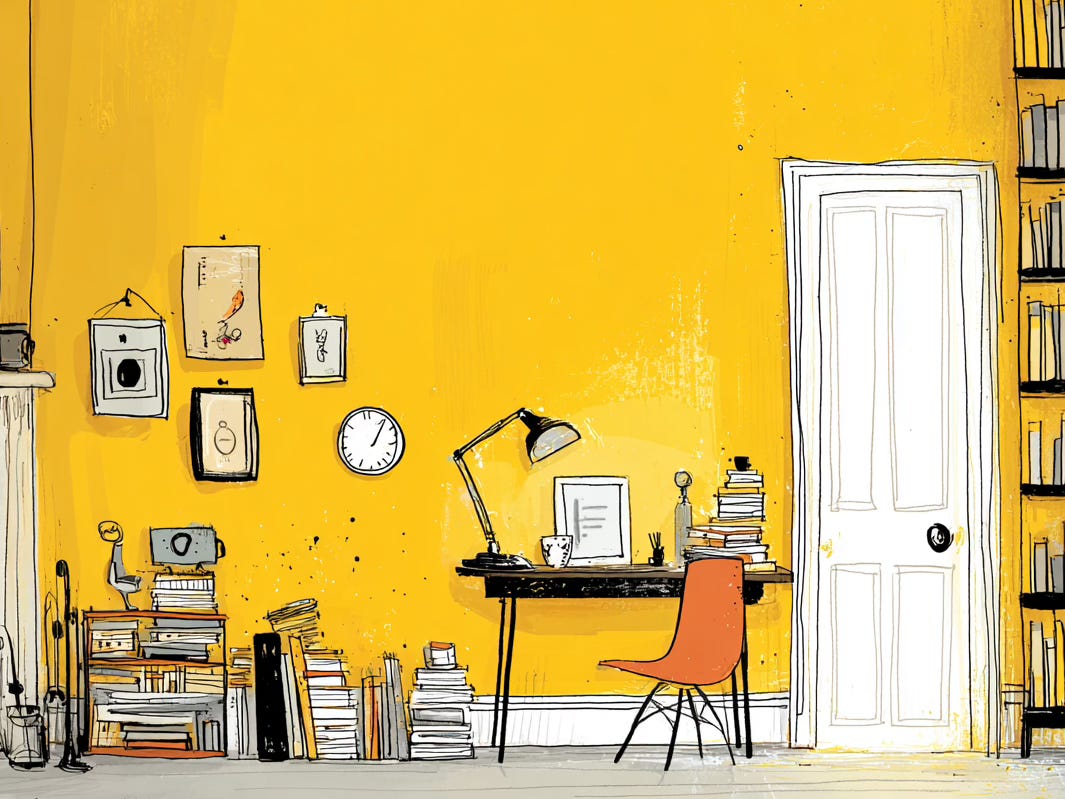
We both collapsed on the floor. Tired of exhaustion.
“We finished it partner,” I said.
“We did, indeed,” she replied. She stood up and walked around the room inspecting my work.
“I must say you did a great job,” she said, inviting me for an embrace.
I was tired and sweaty, but 'why not', I thought. I stood up and went next to her.
She hugged and said “THANK YOU”, in an unusually loud voice.
“Come on, its my house too,” I said.
“No really, thank you for everything,” she said, hugging me tight.
“Wait a minute,” I said, “What’s going on?”
“I am just showing my gratitude,” she said as she held my shoulders and guided me to sit on the sofa.”
Next to me lay a pile of stuff with her old T-shirt on top.
Damn, those Japanese.
i love how it’s so mundane and warm at the same time
This is hilarious and so relatable!Thanks for the laugh.