


“I heard the news,” my colleague whispered, sidling up to me like we were secret agents undercover.
I raised an eyebrow.
Her voice dropped even lower. “You have resigned. Where are you going?” she asked.
Your notice period is like the first trimester of a pregnancy. You only reveal it to your closed ones, there are a lot of speculations around and everyone else seems to be more excited about it. (Given that our notice period was solid three months, the math checked out too)
I had recently been promoted and I was resigning to sit at home and do nothing. This was a difficult thing to explain over a watercooler conversation, so I said, “Yeah, I’ve resigned. I’m joining DMart.”
Her eyes widened. “Oh? Some kind of digital transformation role?”
“No,” I said. “I will be putting stickers on Apples.”
But why quit?
There are many theories on how ‘work’ as a concept originated in the history of human civilization. I haven’t read any of those theories and I’m guessing you haven’t either. So, I’ll just make something up and we’ll all pretend that I’m an expert.
Millions of years ago, somewhere in a cave in central Africa, a caveman shouted, “Let’s go out and hunt a boar!” to which another caveman wearing a finer animal skin responded, “Let’s not get ahead of ourselves. Bob, can you note down the minutes and list all the action items.”
And just like that, work was born.
WORK HAS CLUNG to humanity like a never ending Mortgage Loan. From Mesopotamians building ziggurats to Egyptians stacking pyramids, through Greek philosophers, Roman builders and factory workers powering the Industrial Revolution; human beings worked until the day they died.
Then came history’s greatest tragedy. The average life expectancy of human beings doubled to 70.
Thousands of years ago, when a 30-year-old Aztec blacksmith wished for death instead of another day of hammering, nature said, “Here you go man. Smallpox!” But in the modern world, when a 40-year-old Product Manager says, “I’d rather die than write one more User Story,” capitalism laughs and says, “20 more years of this buddy. You have EMIs.”
The extra years we got after 40 didn’t mean more living—it just meant more time spent working. If anyone questioned the point of all this meaningless grind, it was termed as the Mid-life Crisis.
SINCE I STARTED WORKING, I have always been fascinated by interviews of famous people when they retired. No matter their field, when asked about regrets, they always point out the same things. “I never noticed when my kids grew up” “I wish I had spent more time with my parents when they needed me.”
Whenever I would listen to one of these interviews, I would sit back and wonder, ‘Huh! How come all these smart people who spent their entire life doing amazing things, have the same regret when they are 60. There has to be a better way to live without feeling like a loser at the end of it. Why isn’t somebody working on fixing this problem?’
Then it hit me, I am somebody.
I’ve spent nearly 20 years working on transformation projects. Most of my life I have pretended to work on improving processes and boosting efficiency. I should be the one to figure out how to live an optimal life.
So I did what any seasoned Six Sigma Professional would do, I opened Excel and made some charts.
I charted out two scenarios. One a status quo and the next one the radical experiment.
Scenario 1
If I continue to live my life like everyone does, I work until I am 60, I’ll retire with a mountain load of money (one can always hope). But the trade-off is that I’ll time-jump through my life for the next 20 years, only truly living on weekends and the occasional holidays I manage to scrape together.
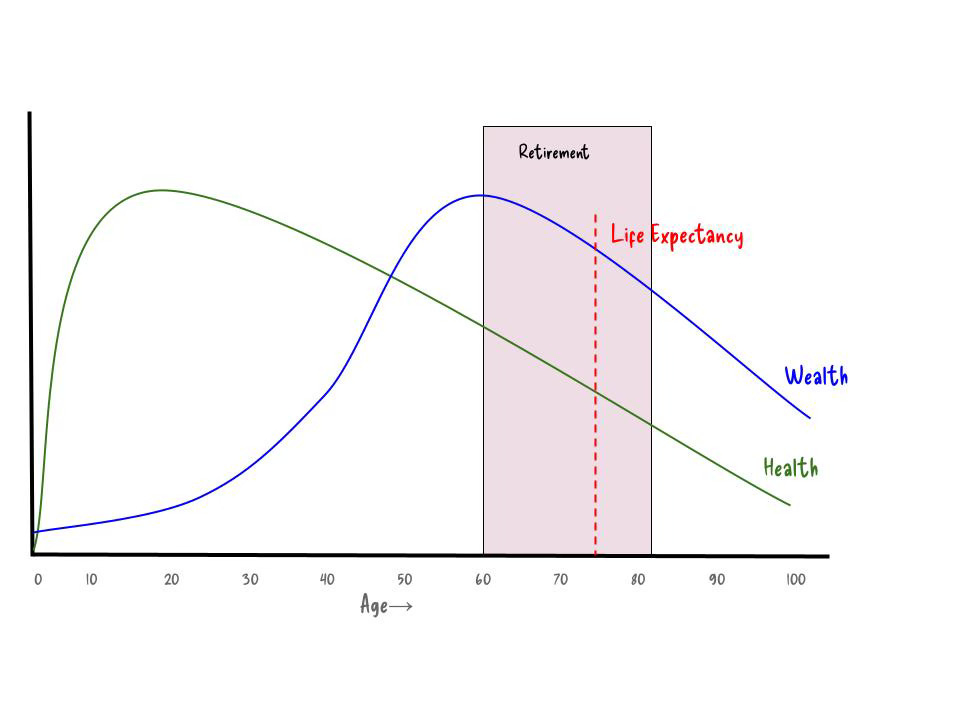
Then there’s the matter of my health. After 40, my body will start crumbling—every extra rupee I earn will come at the cost of my knees, my back and my will to live. Just when I would make up my mind about working on my fitness, I’ll get a shiny new promotion. More money, but also longer hours, more stress and the constant hum of the Microsoft Teams Call, which is the literal sound of your soul being vacuumed out of your body.
Scenario 2
Or—I could stop, say, around 40. But in this version, I get to spend time with my kid while she is growing up. Spend time with my parents while they can still move. Actually focus on my fitness, so that when I turn 60, I’m in a better shape and have better years ahead.
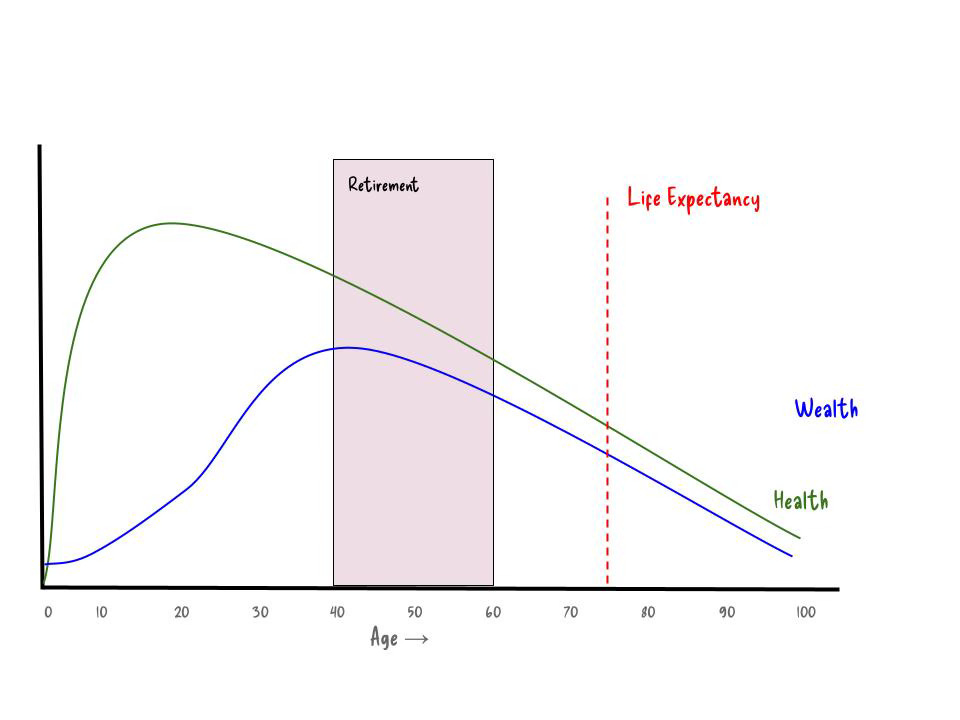
Sure, money will be tight (I’ll get to that later), but I’ll manage. More importantly, I won’t be someone who wagers the best years of their life in anticipation of living fully later, only to die abruptly like a TV show that got cancelled mid-season.
WHEN YOU ARE YOUNG, you're at peak energy but you are pleading with your parents to give you some money because you want to go on that trek. At 60, your bank account is finally smiling, but you are pleading with strangers to give you that lower berth in trains because your knees cannot handle a three step ladder.
Somewhere in between, from 40 to 60, magic happens. You have decent money and your back doesn’t sound like tearing velcro every time you move.
Life is a game you play only once, no replays, no do-overs from zero to seventy-five. I didn’t want to sprint through it like everyone else, only to read a card in the end that says “Thank You Mario. But our Princess is in another castle.”
So after this careful scientific analysis, I came to a conclusion that the best time to live your life is between 40 and 60 and I won’t be renting it out to anyone.
My colleague cornered me with a straight shot, “I saw you liked a LinkedIn post. Joining Salesforce?”
Truth was, I’d been liking random posts on LinkedIn from different companies, just to mess with people.
I put a hand on his shoulder. “Actually, I’m joining MRF.”
He blinked. “From HDFC Bank to MRF? What are you gonna do there?”
I grinned. “You know the MRF logo, right?”
“Yeah,” he said slowly, trying to remember “a guy holding a tire over his head?”
“Yeah. Poor guy's been doing it for years, he’s exhausted. I’m taking his place.”
But what about money?
For the past few years, anyone unfortunate enough to go out on dinner with me found themselves trapped in a questioning session. One question after every drink. These were the questions I was grappling with but I wanted bouncing boards and drunk people never back down from existential conversations.
30ml question
“How much money would it take for you to quit your job and not work anymore?”
It was a subtle way of asking, ‘if all your monetary needs are taken care of, what would you rather be doing’.
Most people would give exorbitant numbers like 50 crores, 100 crores, (something they would never earn even if they worked for next 50 years) but one day someone introduced me to the FIRE.
Financially Independent Retire Early calculates the amount you need to retire. 25x Formula. x being your yearly expenses.
When I crunched the numbers for my FIRE goal, I realized that to hit that number I will have to work until I am 74 years and might get a few seconds to enjoy my retirement before I kick the bucket.
BUT THE TRUTH IS, we overestimate how much money we need in life. The point at which diminishing marginal utility of money kicks-in might vary for different people, but I come from a fairly lower middle class family. I never thought I would have what I have right now. If I could go back in time and tell my 20 year old self the amount of money I would have when I am 40, my 20 year old self would laugh (and probably ask Isn’t there a cure for hair loss in the future).
Then one day it occurred to me, I was looking at it all wrong. Instead of aiming for money to match my expenses, all I had to do was to reduce my yearly expenses.
Not wanting something is as good as having it.
60ml question
“What percentage of the money you earn, you have to spend so that you can keep working?
If I quit your job, many of my expenses would just magically disappear.
I don’t have to buy formal clothes every year.
I don’t have to spend money on travelling to work.
I don't have to spend on perfumes, shoes, ironing clothes or personal grooming products.
I don’t have to spend on day-care and tuition fees. (Why should I outsource parenting?)
I don’t have to go to those unnecessary office lunches and dinners.
When I calculated this, somewhere around 12% of my income was the subscription fee for just being employed.
90ml question
What is the premium you pay on stuff because you are working Monday to Friday?
I call it The Working Man’s Surge Pricing.
You’d be surprised how cheap is everything on a Monday afternoon. The world is designed around working hours. You can watch the same movie in the same theatre for less than half of the price on a weekday during office hours.
Flights & Hotels are cheaper on weekdays.
Holidays are cheaper if they are not taken on long weekends.
When you are working you say, “I Don’t have time, I’ll just pay extra to get this done.” When you are not working, you say, “I can do it whenever it is the cheapest.”
When you are not working, you have less, but you also spend less on same stuff.
WE MEASURE MONEY in terms of salary, but we rarely calculate how much of it is spent just to keep earning it. We assume making more means spending more on things we enjoy. But in reality, a big chunk of that paycheck goes right back into the system, just so you can keep showing up to earn it again.
He sat down on the empty chair next to me in the cafeteria. "Why did he walk away like that?" He asked, signalling to the colleague who was sitting next to me.
"Some call he had to attend," I lied. Truth was, the colleague saw him coming and bolted.
Some people are conversational black holes. Once you get too close, they suck you in, and suddenly, you’re trapped in an endless monologue about the boil they got under their armpit. This guy was one of them. If you get caught in a conversation with him, you need a solid exit strategy.
I was done with my lunch and two months into my notice period, I did not have anything better to do, so I stayed put.
"So! Lots of rumors floating around," he laughed, as he gave a light punch on my shoulder.
By now, most people had stopped asking where I was going next. They knew, if they did, they’d get an answer stranger than how the Joker got his scars.
But this guy wasn’t one to let things go.
"I think I know what you are doing next," he said.
"You do?" I asked, humoring him.
"You’re starting your own venture! That’s why you are keeping it hush-hush," he said, proudly.
I looked around dramatically. "How did you figure it out?"
He smirked. "You’ve always been a guy with big ideas… entrepreneurial and all."
I nodded seriously. "Come, let’s walk." I placed a hand on his shoulder and steered him out of the cafeteria. These things can’t be discussed in public.
Once we were out, I leaned in and said, "Okay, do not mention it to anyone. I’m starting an FMCG business."
His eyes narrowed. "You’re just messing with me, like you do with everyone else. Reel them in with serious talk, then hit them with the joke."
"No! This time I am serious," I said in all earnestness.
"I thought you’d do something in fintech space," he said, sounding disappointed. “FMCG is such huge investment.”
"I just spent 10,000," I said. "It is quite easy, you can do it too!"
"What?" He blinked.
"See, all you have to do is pay ten thousand for these premium products and then you find three people who will pay ten thousand each. Boom! Money starts rolling back to you month after month. Trust me, it’s a full proof business. I have already added 2 people, you can be the third."
I felt his shoulder subtly slipping from my grip, so I held him tighter.
"Within a year, you’ll have a BMW," I said.
He gulped.
“So, should I register you to the seminar? There is one in Chandivali tomorrow,” I said, as he finally freed himself from my grip.
"Nice, nice… I have a meeting—I’ll think about it," he said, walking away.
"Why are you walking away like that," I shouted, "Call me—"
I never heard from him again.
But you can’t be sitting home and doing nothing?
You must do some kind of work, they say. Khali Dimaag Shaitaan Ka Ghar. You can’t be doing nothing.
Why not? Why can’t you be idle? Who truly benefits when your hands are never idle? When your mind is never free?
Technology has received a fair share of criticism for making us dumb, shortening our attention span and feeding us distractions. But what fuels this machine?
Work is the great enabler of the attention economy.
After a draining day at work you could go on a long walk and clear your mind. It costs nothing. But long walks are not good for the economy. Long walks do not add to the GDP.
So the geriatric billionaires will tell you to work 50, 70, 90 hours a week and invoke your patriotism. Tech bros will tell you that weekends are a Western construct, that leisure is for the weak. The same people who have never known a true moment of connection in life will joke—How long can you stare at your wife?
They don’t want you to go for a long walk after work. They don’t want to give you time to introspect. Longer working hours are great for the economy. After a long intense day at work, if you have no time for deep recovery or space for self-reflection, it will breed Anxiety. And anxiety fuels consumption.
When you are anxious, you’ll pick up your phone and chase the most trivial form of happiness available. You’ll binge-watch a show so mindless that even the studio executives call it “second-screen worthy”—where every plot point is spoon-fed to you in real-time.
At some point in the show, as a part of product placement strategy, an actor on-screen will brew coffee in an absurdly expensive coffee maker, the camera will zoom into the brand name and just like that, you’ll think ‘I need a coffee maker.’ I work so hard, I deserve it. Without hesitation, you’ll grab your second screen and order it on a quick-commerce app (because in this version of capitalism, we don’t want you to rethink your purchase decisions).
As the episode limps toward a lazy cliff-hanger and the "Next Episode" button slowly lights up, you’ll find yourself refreshing the delivery tracking. Not because you’re desperate for that coffee maker—but because you long for that little dopamine hit when it gets delivered. That is the only thing keeping you from thinking about how miserable your workday was. That is the only form of happiness that you are allowed in the limited time you have.
When you sleepwalk through your non-working life, you will have no space to come up with an alternate value system.
IF COVID TAUGHT ME ANYTHING, it's that most of us have jobs that wouldn’t be missed if they stopped existing. While doctors, cleaning workers and power grid operators kept the world running, the rest of us just kept showing up on Zoom calls pretending to work.
Work can be defined in two ways:
Scientific Definition of Work - altering the position or the state of matter.
Political Definition of Work - telling other people what to do.
One pays peanuts, the other pays absurdly well. So, naturally, we invented more of the second type. Team leads, managers, senior managers, VPs, directors, C-suite executives. And when we ran out of titles, we created consultants and hired trainers.
Modern economy is nothing but a giant Ponzi Scheme.
There’s a limit to how much real work we can do. You can only build so many bridges, make so many medicines, or grow so much food before things get cluttered. But fake work? That’s infinite.
And so, to justify all these jobs, we had to invent things for people to sell. Skin-whitening creams. Conditioners—but for clothes. Shoes with air suspension. Cars with ventilated seats.
The truth is, humanity has already done most of the necessary work. At this point, the only people we really need are scientists and the folks keeping basic services running. Everything else? Just another way to keep the corporate hamster wheel spinning while we slowly set the planet on fire with unnecessary work.
I would rather let Satan find mischief for my idle hands.
So you’ll never work again?
Of all the questions I’ve been asked over the past year, this is the one I’ve given the most serious thought to.
Will I ever go back to work again?
All this posturing and ‘down with the system’ rhetoric is fine on paper, but what if something goes wrong?
There are countless things that could go wrong.
What if tragedy strikes my family?
What if my savings dry up faster than I anticipated?
What if, without work, I start losing my mind?
People have posed many such scenarios, and I’ve considered them all carefully. And yet, despite the risks, I’ve come to believe that I could endure them. It would be difficult, but none of them would push me back to the life I left behind.
Except for one.
There is one scenario—just one—that keeps me awake at night. Over the past year, I’ve played it over in my mind countless times. And every time, I come to the same grim realization: if this happens, I will have no choice. I will be forced to return to work.
Here is the one scenario that can break me.
See, I imagine a few years from now, I will most probably move out of the city life. Somewhere in a remote village. I’ve embraced the simple life where I grow my own produce and I spend my days tending to plants, taking care of cattle and chopping wood.
In this scenario, one morning, as I’m mid-swing with my axe, I hear a low distant hum. I see a dust cloud close to the horizon. As I stare at it, it keeps getting closer.
I sigh and stab the axe into the stump. I go to the nearby tap to wash my face and gulp water directly from the tap. The vehicle that was creating the dust cloud screeches to stop in front of my house. I wipe my face with a ragged cloth and walk towards it. The doors open. Two men in formals and wearing blue lanyards step out.
"We knew you’d be difficult to find," the shorter one of them says, brushing dust off his sleeve. "But we didn’t expect this much."
I cross my arms. "What do you want?"
They both look at each other and then the taller one says, "We're from the bank."
I exhale sharply through my nose. “Of course you are! Why are you here?”
"There’s a situation at work," he says, "with Excel."
I shake my head. "You know, I’ve left that line of work."
"We know," the shorter guy chimes in. "But this is important."
He steps forward, his voice dropping and desperate. "The whole country’s financial system is dependent on getting the VLOOKUP right."
I squint.
He continues, "There’s no one that could do this like you… we tried… but the formulas… they just keep returning #N/A."
A single bead of sweat rolls down his temple.
I take a deep breath and stare off into the distance, contemplating my decision. My country needs me.
"Fine," I say, adjusting my sleeves. "But I work alone."
That’s the scenario.
If, and only if this happens, I will go back to work.
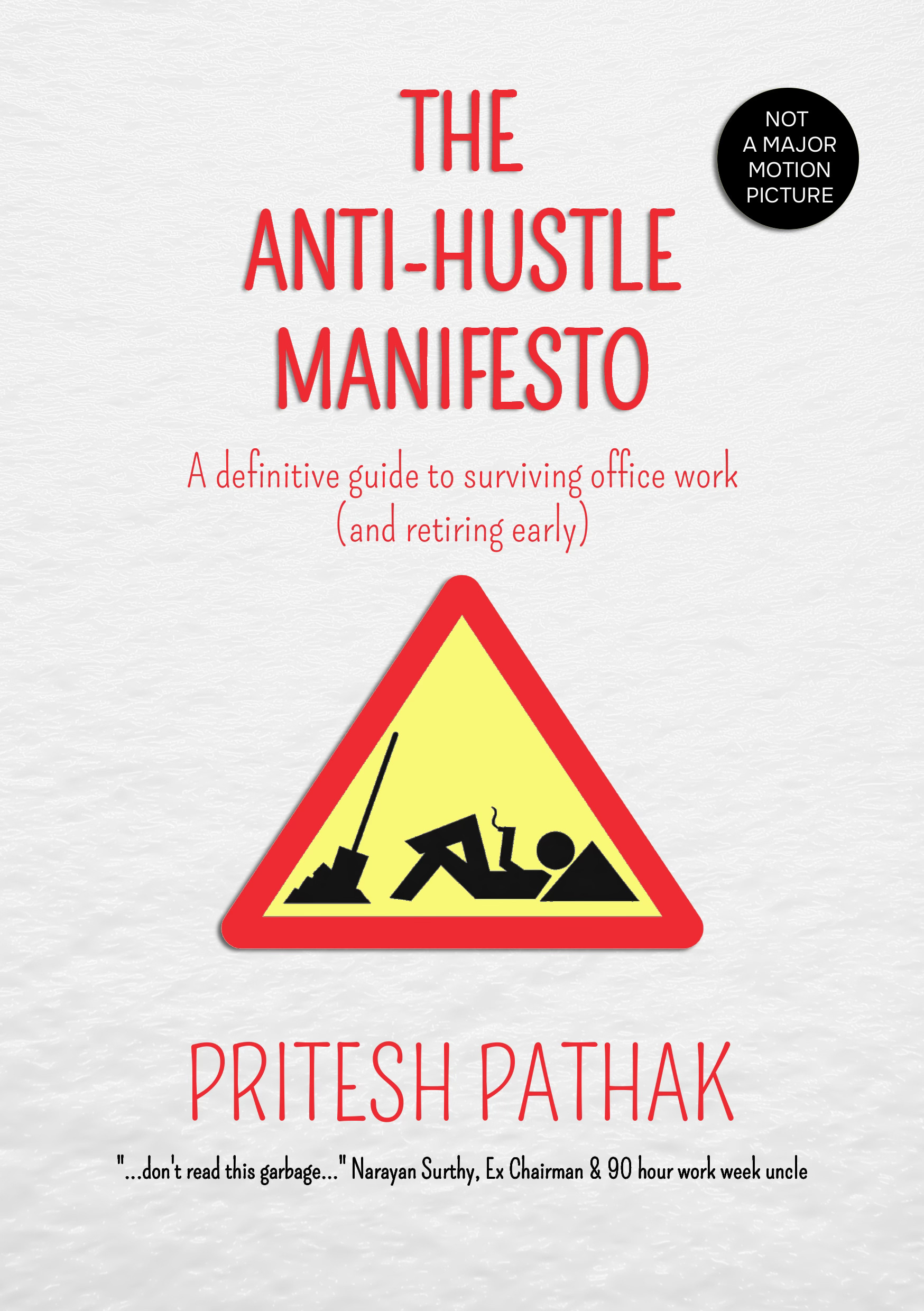
The above piece is an excerpt from my upcoming book:
Read other published excerpt here:

It's a great article but so happy to see Chandivali reference. Finally someone has not called it Powai. Personally I use Powai when I need something or want show off and Chandivali when I want pay for something
Wow. Thoroughly enjoyed reading this. I have also taken early retirement and could resonate with so much of what you said. I am also convinced that I am never going back to work. Thank you for writing this.